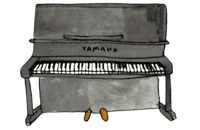


Yamaha U3 vs U300, U30, UX-3, UX30, YU3, YU33, YUS3, YUA, YUX - Which are best?

I've converted all of my best Yamaha piano knowledge into a free PDF. Pop your email in below and I'll send it straight over
OK, let’s try and make sense of the various Yamaha upright piano models through the past few decades. Here goes! (and please tell me if you think I got any of these in the wrong order!)
- Yamaha U3 – Excellent! (1950s – present)
- Yamaha U300 – A younger version of the U3, built for export (1990s)
- Yamaha U30A and U30BL – Better than the U3 with improved hammers and action (80s, 90s)
- Yamaha X – Has the x-brace around the back for improved projection. (70s)
- Yamaha UX-3 – Better than a U30A / U30BL. Has the x-brace (80s, 90s)
- Yamaha UX30BL – Better than a UX-3 (80s, 90s)
- Yamaha UX30A – Better than a UX30BL. Grand piano style music desk & shelf (80s, 90s)
- Yamaha YUA/YUX – 70s-90s. Large music desk. Top-tier features (70s-90s)
Younger and/or more obscure models
- Yamaha YU3 – Improved cabinet and tone (2000s-2010s)
- Yamaha YU33 – Replaced the YU1 (2000s-2010s)
- Yamaha YUS3 – Improved hammer felt, softer tone. (2004-present)
- Yamaha SU7 – Yamaha’s current flagship upright piano
All of the above pianos in order of quality
- Yamaha U3
- Yamaha U300 (because it’s younger)
- Yamaha U30A / U30BL (because it’s upgraded)
- Yamaha X
- Yamaha UX-3
- Yamaha UX30BL
- Yamaha UX30A
- Yamaha YU3
- Yamaha YU33
- Yamaha YUS3
- Yamaha YUS5
- Yamaha SU7
Random points:
- The U30 and UX30 variants have a slightly more slender cabinet design. The arms and feet are narrower. The U3 is slightly beefier.
- The U30 and UX30 variants don’t have a lock and key, so can’t be locked. The U3 can be locked with a key.
- The UX-3 has chunky square corners at either side of the keyboard.
- The UX-3 has vents in the front panel to allow the sound to escape more directly (negligible difference to be honest)
- None of this really matters. Just sit down and play. The best piano is the one you enjoy most.
- The U30A has a line of beading running left to right near the top of the top panel. It’s a nice touch.
So there you have it. They are all wonderful pianos but each one on that list is slightly better than the one before.
But wait, there’s more…
Whilst researching for this article, I found myself jotting down the differences in the cast iron frame designs of the various models I was inspecting. Here are my findings so far after inspecting a handful of U3H, U3M, U3A, X, U30A pianos;
- The iron frames of are usually embossed with a large number behind the bottom board.
- The iron frames usually have “Nipon Gakki” embossed behind the bottom board
- Oddly, U3H made in 1978 (28087xx) had a large “1” embossed on the iron frame but U3H made in 1973 (16490xx) had a large “2” embossed in the same place. How can it be that the 1978 frame is “1” but the 1973 frame is “2”. Confused!
- Interestingly, I found that both of the Yamaha X pianos I checked (1975 and 1977) were embossed with “2” which is the same as the 1973 U3H.
Anway, that’s numbers 1 and 2 accounted for. I couldn’t find any number 3 frames but I’ll keep looking and update this article when I do. Read on to see where frame numbers 4 and 5 came from
- I found “4” embossed on 2 different U3 variants which also caught me by surprised. A 1981 U3M (33282xx) was embossed with a “4” and so was a 1983 U3A (37097xx). Strange!
- Number “5” turned up, wait for it, embossed on a 1982 U3M!
- So 1981 U3M and 1983 U3A had “4” but a 1982 U3M had the “5”. Very very strange indeed.
Anything else of interest?
Oh yes! I found other interesting things. Here goes;
- A 1980 U3H (30611xx) had no embossed number at all on the frame. Odd!
- All of the pianos mentioned above had an interrupted capo bar in the treble apart from the 1973 U3H which had a solid/continuous capo bar in the treble.
- Further, I noticed that most of them had a rounded cap bar design but some had angular designs. This is so insignificant that I can’t bring myself to list which ones were which (you’re welcome!)
What about the U30 variants?
Well…..
- U30A and U30BL appear to use the same iron frame design
What next?
- Measure bass string length
- Measure key length
- What else should I compare?
Any more?
Sadly yes;
- U3H did NOT say “Nippon Gakki” or have a plate number embossed on the iron frame behind the bottom panel
- U3A had plate number 302080750 embossed
- U3M 36222xx had 209030322 and Nipon Gakki embossed
- U3M 33282xx had 102110609 embossed
- X 1973 had NO Nipon Gakki but 450616383 plate number
- X 1975 had NO Nipon Gakki and 47040628 plate number
- U3H 28087xx had NO Nipon Gakki but had 481226185 embossed
- U3H 30611xx had Nipon Gakki but no plate number
- All very random and odd
I’ll let you get back to your supper now
Thanks for reading
When do I get my OBE?
Mark
Created: 28 May 2025
Modified: 28 April 2026