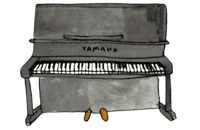


Yamaha Disklavier Grand Pianos
A Disklavier is a real Yamaha acoustic piano with a clever system built in. It can play itself, record what you play, and on newer models stream music and lessons. Disklavier grands come up second-hand more often than you might think, and they can be very good value.
How do you spot a Disklavier grand?
Look for a control box or panel under the keyboard on the left, and “Disklavier” on the fallboard or control unit. The model name usually starts with a D, for example DGB1, DGC1, DC1, DC2 or DC3. Some older models are a G-series grand with a Disklavier system added, such as a G5 Disklavier.
The different generations, in plain English
Yamaha has made several versions over the years. The main ones you will see second-hand are:
- Early Disklaviers (Mark II and similar). These used 3.5-inch floppy discs. The piano itself can be lovely, but floppy discs are now hard to live with.
- Mark III and Mark IV. Later systems with CD drives and more connections.
- E3. A simpler, later system that is still widely used.
- ENSPIRE. The current generation, with app control and streaming.
The newer the system, the easier it is to use day to day. But the piano matters most. A great piano with an old system is often a better buy than a tired piano with a new one.
Can an old floppy-disc Disklavier be brought back to life?
Often, yes. Older systems have standard MIDI connections. With the right adapter, an old Disklavier can play music from a tablet or phone without touching the original floppy drive. We have done exactly this with a 1990 Disklavier in our own showroom, and it now plays thousands of pieces from an app.
So do not write off an older Disklavier just because the floppy drive is out of date.
The pros
- It is still a proper Yamaha acoustic piano first.
- Plays itself beautifully for parties, restaurants, hotels and care homes.
- Records your playing, which is a brilliant learning tool.
- Second-hand Disklaviers often cost far less than the new price.
The cons
- More parts means more to check. A faulty system can be costly to repair.
- Older systems may need adapters to work with modern devices.
- Some Disklavier systems add weight, which can affect moving costs.
What to check when buying a used Disklavier grand
- The piano first: hammers, tuning pins, soundboard and case, exactly as with any grand.
- That the system plays back on every key and the pedals move during playback.
- That recording works.
- Which generation it is, and whether all the cables, controller and manuals come with it.
- The serial number, using our free serial number lookup.
Who should buy one?
- Homes, venues and businesses that want live piano music without a pianist.
- Players who want to record and hear themselves back.
- Anyone who wants a Yamaha grand and fancies the extras for not much more money.
Conclusion
A used Disklavier grand can be a wonderful piano with a party trick or two. Buy the piano first, check the system second, and do not panic about older floppy-disc models.
Thinking of selling your Yamaha Disklavier grand?
We buy Disklavier grands of every generation, including older floppy-disc models that other dealers turn away. We know how to bring old systems back to life, so they do not put us off.
We have specialised in Yamaha pianos since 2002. You can sell to us in one of two ways.
- Sell outright. We make you an offer, collect the piano, usually within a week, and pay you by bank transfer.
- Sell on commission. We collect your piano, bring it back to showroom condition, and sell it from our showroom. You get a fixed, guaranteed amount when it sells. If it hasn’t sold within 12 months, we pay you anyway.
Either way, collection from a ground floor room anywhere in the UK is free. There is no obligation, and we won’t add you to a mailing list.
What we need from you
- The serial number. On a Yamaha grand it is stamped on the iron frame, near the tuning pins. Lift the lid and look just behind the music desk.
- A few photos: the whole piano with the lid up, the keys, and the serial number.
- Your postcode, and whether the piano is on the ground floor.
- Which Disklavier system it has, if you know, and whether the controller, cables and manuals are with it.