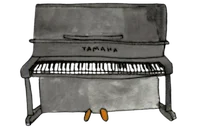


Yamaha DU1E3 Disklavier piano review and information
The Yamaha DU1E3 is a Yamaha U1 upright with a Disklavier E3 system built in. It is a proper acoustic piano that can also record your playing and play it back by itself, with the keys and pedals moving as if someone invisible were sitting at it.
Yamaha made the E3 from about 2009 until 2016, when it was replaced by the Disklavier ENSPIRE. So every DU1E3 is now second-hand, and most are between 10 and 17 years old. Here is what you are buying, what to check, and when a plain U1 is the better choice.
What the name means
- D stands for Disklavier, Yamaha's name for its self-playing pianos. The first one appeared in 1987. Our Disklavier grand pianos guide explains the different generations.
- U1 is the piano itself. It is Yamaha's best-known upright, 121cm tall.
- E3 is the version of the Disklavier system. Yamaha launched it as a simpler, cheaper Disklavier for home use, sitting below the more expensive Mark IV of the same period.
You may also see it written as DU1 E3 or DU1E3 PE. PE means polished ebony, the usual black finish.
The U1 underneath
Take away the electronics and you have a U1, one of the uprights we sell most often. It has a reliable action, a clear tone and a size that fits most homes. Everything in our Yamaha U1 guide applies here too.
This matters because the piano will outlast the electronics. Judge a DU1E3 as a U1 first. If the piano is good, the Disklavier is a bonus. If the piano is tired, no amount of clever technology will make it nice to play.
What the Disklavier does
- Plays by itself. Small electromagnets under the keys move them, so the hammers strike the strings and you hear the real piano, not a recording.
- Records you. Sensors pick up which keys you play, how hard, and how you use the pedals. Press play and the piano repeats your performance.
- Plays along with other sounds. Built-in speakers can add backing such as strings, bass or drums while the piano plays its part.
- Plays music from a CD or memory stick. The control unit has a CD drive and USB sockets. It came with Yamaha music CDs and built-in songs.
- Remote control and app. It has its own remote, and Yamaha released an iPhone and iPad app for E3 pianos running firmware version 3.0 or later.
For a learner, recording is the most useful part. A child can record a piece, then sit back and hear exactly what they played. A teacher can record a piece for them to listen to at home. For everyone else, it is simply lovely to have a piano that plays itself at a party or on a quiet Sunday.
Does it have a silent mode?
Not always. Yamaha's own E3 manual says the silent function only applies to models fitted with it. Where it is fitted, a lever stops the hammers before they reach the strings and you hear a digital piano sound through headphones or the speakers instead.
Check before you buy. Look for a headphone socket and a silent lever or switch, and try it. If silent practice is the main reason you want one, a U1 with a modern silent system may suit you better (see below).
Things to know about the age
The E3 was built in the days of CDs and USB sticks. That still works, but some parts of the system have dated.
- Internet features. The E3 could stream Yamaha's DisklavierRadio over the internet. That service was built for this generation, so don't assume it still works and don't pay extra for it.
- CD drives wear out. They are the part most likely to fail. A USB stick does the same job for most people.
- Repairs need a specialist. An ordinary tuner can tune the piano. The Disklavier system needs a technician who knows it, and there are fewer of them than there are tuners.
None of this is a reason to avoid one. It is a reason to pay a fair price for a piano with an older system, rather than a price close to new.
What to check before you buy one
- The piano first. Play every note. Listen for sticking keys, uneven notes and buzzes, just as you would on any used U1.
- Playback on every key. Play a song with lots of notes across the keyboard. Watch for keys that don't move, play too loudly or too softly, or repeat badly.
- Noise. All self-playing pianos make a little mechanical noise. A steady hum or a loud clatter is not normal.
- Record and play back. Record yourself for a minute and play it back. It should sound like you.
- All the parts. Make sure the control unit, remote, power lead, speakers and manuals are there, and that the CD drive and USB sockets work.
- Who has serviced it. Ask whether a Disklavier technician has looked at it, and when.
Our Yamaha serial number lookup will tell you roughly when any Yamaha was made. A DU1E3 with a serial starting 634, for example, was made in about 2012.
Size
121cm tall, 153cm wide and 61cm deep. It weighs around 261kg, about 30kg more than a plain U1 because of the Disklavier parts. It needs the same space as a U1, plus room for the control box under the keyboard and a power socket nearby. Our U1 dimensions guide has more detail.
What to pay
We don't sell many Disklaviers, so we won't quote a price we can't back up. The best guide is the new equivalent. Yamaha's recommended price for a new DU1 ENSPIRE ST is over £21,000, and UK dealers sell it for around £17,000. A used DU1E3 is a much older system and should cost a great deal less.
If you mainly want a good piano you can play quietly, there are simpler routes.
- A reconditioned Yamaha U1 gives you the same piano without the electronics to look after.
- We can fit a silent system to a U1 or U3 for £2,490. Our silent Yamaha pianos guide explains how it works.
- Our used Yamaha piano prices page shows what ordinary U1s and U3s cost.
Our verdict
The DU1E3 is a good U1 with a clever party trick that is also a genuine help to learners. Buy it for the piano, enjoy the Disklavier as an extra, and have both checked by someone who knows them. If you never expect to use the self-playing or recording, a plain U1 is cheaper to buy and simpler to own.
Every piano we sell comes with 0% finance options, a free first tuning and 14 days to change your mind.
Selling a DU1E3?
We are always looking for good Yamaha uprights, including Disklavier and silent models. Send us the details on mgps.uk/sell and we will come back to you with an offer. We arrange and pay for the collection.