


Why Mark Goodwin Pianos Is the Best Place to Buy a Yamaha Piano
Written with Mark Goodwin, founder of Mark Goodwin Pianos, who has traded pianos since 2002 and specialised in reconditioned Japanese Yamaha pianos since 2003.
The short answer
My name’s Mark Goodwin. I run Mark Goodwin Pianos (MGP) with a small team based in Manchester and London, and we specialise in one thing: reconditioned Japanese Yamaha pianos. We’re not a Yamaha-authorised dealer, and we don’t do new pianos or digital ones. What we do have, at any one time, is around 40 reconditioned Yamaha U1 and U3 uprights and grands on the floor, plus documentary records covering more than 3,600 pianos imported from Japan since 2007.
If you can get to Manchester or London, book a private hour with us, try several pianos side by side, and take your time. If you can’t, we’ll send you close-up photos and a proper video of the exact piano you’d be buying, not a stock shot of “a U3”, so you can judge it for yourself before it turns up at your door.
We put “best” in the title because that’s what people search for, and because after more than 20 years doing this, I genuinely think we’ve built something worth comparing to anyone else. Read on and judge for yourself: how many pianos you can actually put your hands on, what happens to each one before it reaches the showroom, who does the work, and what happens if it all goes wrong. No smoke, no mirrors, just have a read.
Who we are, and who we’re not for
We call ourselves the “Yamaha Piano Specialist” because that’s exactly what we are, and nothing more. We’re independent, not part of Yamaha’s dealer network, which means we choose our own suppliers in Japan, set our own reconditioning standards, and only sell pianos we’ve picked ourselves. No badge on the wall telling us how to do our job, just us doing it our way.
That suits a particular kind of buyer: someone who wants a reconditioned Yamaha upright or grand, wants to compare a few before deciding, and would rather have an unhurried private appointment (or a well-documented remote purchase) than wander round a huge showroom full of different brands. It also suits people who like to see the evidence for themselves rather than take a salesman’s word for it, which is really what this whole article is for.
It won’t suit everyone, and I’d rather tell you that now than waste your time. We don’t sell new or digital pianos, so if that’s what you’re after, you’ll do better elsewhere; a decent retailer offering a home trial is usually the right call for a digital instrument. If your budget’s a bit short of our stock range, my own site, whichpiano.co.uk, is a good place to start, and a cheap digital piano to tide you over while you save is a sensible move. And if you want one roof with ten different brands under it, our range will feel narrow, because it is; we do one thing.
Why depth of stock matters
We typically carry around 40 pianos, with more coming through the workshop behind the scenes. When I last checked, that included Yamaha grands and baby grands, several standard and premium U1s, and several standard and premium U3s. Stock moves week to week, so treat that as a snapshot, and check our current listings before you visit.
This article’s mostly about the U1 and U3 uprights, since that’s most of what we sell and most of what people ask about, but we regularly have grands and baby grands too, from the smaller G1 and C1 up to big concert instruments like the C7. Everything in this article, the private appointments, the exact-piano photos and video, the aftercare, applies across the whole range.
Here’s why depth matters. No two pianos of the same model are identical, even if they left the Yamaha factory the same year. Decades of use, climate and the specific reconditioning each one’s had all shape how it feels and sounds. If you can only see one U3, you’ve no way of knowing whether it’s typical or a bit unusual. If you can compare four or five, at different ages and finishes, in the same session, you can actually start to work out what you like.
There are other good dealers selling Yamahas, Yorkshire Pianos, Chamberlain Pianos, Pianos Direct, Coach House Pianos, McLaren’s Pianos, UK Pianos, J. Reid Pianos among them, and I’d say so honestly. Some hold Yamaha certification, which brings its own guarantee. But when I looked at what they had listed publicly, few showed as many individually photographed, currently available reconditioned Japanese U1s and U3s at once as we typically do. Stock changes overnight everywhere, so take that as a snapshot rather than a permanent scoreboard.
A few examples. Yorkshire Pianos list Yamaha Certified Reconditioned U1s and U3s with a ten-year dealer guarantee, but what’s visible tends to be one representative U1 and U3 rather than a bench of individual pianos to compare. Chamberlain Pianos is a big multi-brand retailer with dozens of Yamaha upright listings, but when I checked only two were certified reconditioned U-Series pianos; the rest were new or other ranges. Coach House Pianos offer video demos and their own 14-day return window, both genuinely good things, but their pre-owned U-Series stock was a small selection alongside new pianos. None of that makes them worse dealers. It just means their strength is elsewhere, Yamaha certification, brand breadth, manufacturer cover, while ours is having more directly comparable reconditioned Japanese Yamahas on the floor at once.
What a private showroom appointment actually feels like
Come and see us in Manchester or London by appointment, an hour as standard, longer if you ask, we’ll fit you in when the diary allows. No pressure to buy, and bring your piano teacher or anyone else you trust along for a second opinion.
Manchester’s at Stadium Works in Royton, Oldham. London’s on Lombard Road in Battersea. Both have plenty of free parking, and both are proper showroom spaces inside bigger warehouse buildings, not a shopfront squeezed onto a high street.
In Manchester you’ll usually be looked after by Oliver, a working jazz pianist who’ll play each piano so you can hear it from across the room as well as up close, and talk you through what’s different between models in plain English. In London it’s usually Dexter, a singer-songwriter and pianist, doing the same. Both get paid the same flat fee whatever piano you choose, no commission, so there’s no reason for either of them to steer you towards something pricier.
Want to see inside a piano before you buy it? Just ask. We’ll happily take the panels off, and often offer to anyway, because most people find the mechanism fascinating once they’ve seen it.
We only have two showrooms, so plenty of people travel from well outside Manchester or London, Liverpool, Birmingham, further afield, just to compare several pianos in one visit rather than settle for whatever the nearest dealer happens to have that week. Whether that trip’s worth it for you depends on how much you value that comparison against the convenience of somewhere closer. Hopefully this article gives you enough to make that call yourself.
How remote recommendation and exact-piano buying work
Not everyone can get to a showroom, or wants to. Every piano on our website normally has around 12 photographs and a proper performance video of that actual piano, not a generic clip of “a U3”. Two pianos of the same age and model can still sound and feel different, so a recording of the specific piano you’d be buying tells you more than any manufacturer’s promotional video ever could.
I’ll be straight with you: no video or photo fully captures the bass, the dynamic range or the touch of a piano sitting in your own room. If you want more reassurance before buying remotely, just ask and we’ll record an extra demonstration for you.
Each piano’s page has everything together, photos, video, and a note of the work done on that specific instrument, with the serial number partly masked for the previous owner’s privacy. The idea is you shouldn’t have to take our word for anything you can’t also see for yourself.
If you’re not sure which model’s right, or you live too far to visit, ask us to choose one for you. You order online, get an invoice and payment instructions, and then our specialist piano movers get in touch to arrange delivery once payment or finance is sorted. One recent Trustpilot review describes exactly this: a Yamaha U1 bought entirely sight unseen, based on our video and advice, and the buyer was happy with what turned up.
We film stock videos on a Panasonic Lumix G9 with Rode mics, and we balance the audio to give a fairer sense of how the piano actually sounds rather than a flattering studio effect. Our Vimeo archive has over 2,500 videos going back roughly 13 years, which should tell you this is a long-standing habit, not something we started for this article. That said, don’t read the video count as an exact tally of pianos sold; some listings have more than one video of the same piano.
The journey from Japan to the UK showroom
I’ve been trading since 2002, when I started out selling Bechstein and Steinway grand pianos from my dad’s garage. From 2003 I moved towards Yamaha uprights, and in 2007, the year after a flood wiped out our earlier grand piano stock (more on that below), we imported our first proper container of Japanese Yamahas. Sixteen uprights, twelve U3s and four U1s, roughly the same 75/25 split we still sell today.
Since 2007, our order, shipment and invoice records show that we’ve imported 3,664 pianos from Japan. Japanese Yamaha pianos have been at the core of the business throughout that period.
To make that claim checkable, we’ve published a public evidence register with private commercial details removed. It contains 2,206 model and masked-serial records, with a further 1,458 pianos supported by reconciled final shipment, order and invoice totals.
Download the public piano evidence register
Read how the figure was checked and what the register contains
Every U1 or U3 we sell is genuinely made in Japan, checked by model and serial number. Yamaha’s own published guidance confirms that uprights over 45 inches tall, which covers both the U1 (about 121cm) and the U3 (about 131cm), were built at their Hamamatsu factory in Japan, not overseas.
We import pianos from Japan through our Japanese suppliers. Restoration and preparation take place within their workshop network before shipment, then further work is carried out here in our UK workshop. That’s a supplier relationship built on standards agreed in advance, not me personally selecting every piano in Japan, which wouldn’t be realistic at the scale we import.
The best piece of proof I can offer for all this is a photo from 2010, when my wife Julie and I visited a piano restoration workshop in Tokyo. It shows the two of us next to an upright with a handwritten label carrying my name, the model, a Yamaha U3M, and a serial number, real, physical proof of a piano moving through the same supply chain we still use today.
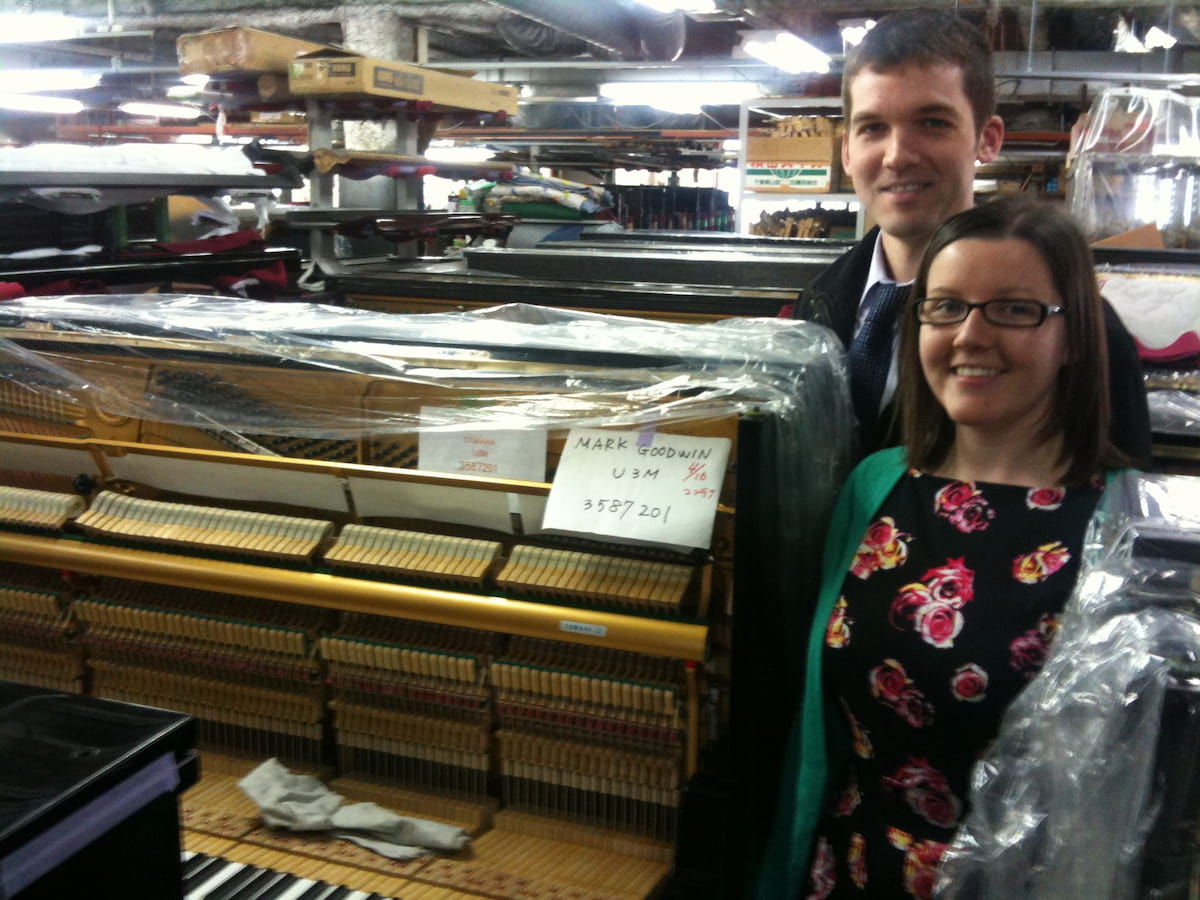
Mark and Julie Goodwin at a piano restoration workshop in Tokyo, 2010. The upright behind them is tagged for Mark Goodwin, model Yamaha U3M, serial number 3587201.
Honest provenance: what we can and can’t tell you
We can’t trace every piano back to a specific family in Japan. U1s and U3s were mass-produced, mass-exported instruments, and no UK dealer, us included, can normally piece together a full ownership history for an individual piano.
What we can tell you a lot about is condition. Hammer felt depth, wear in the action, the state of the cabinet, all of that gives an experienced technician a good read on how heavily a piano’s been used, even if it can’t prove who owned it or how well they looked after it. Some imported pianos come with Japanese tuning-history cards, handwritten notes from past tuners, which are a nice glimpse into a piano’s past, though plenty are blank and shouldn’t be treated as a complete record.
If another dealer tells you they can guarantee every piano came from one private owner, it’s fair to ask what evidence backs that up. A confident sales pitch isn’t the same as a paper trail.
There’s one exception. If a piano we originally sold comes back to us, part exchange, our upgrade scheme, a buyback years later, we can trace our own sales history for that piano: when we sold it, and to whom. That’s our own record, not proof of its earlier life in Japan, but it’s real and it’s specific, and it’s there because we’ve kept proper records.
How supplier reconditioning and UK preparation fit together
Reconditioning happens in two stages. The bulk of the structural and mechanical work, plus basic regulation, is done within our suppliers’ workshop network before shipment. Once a piano lands in the UK, our own team takes over: tuning to concert pitch, fine regulation, voicing where it’s needed, and in most cases polishing the cabinet again.
That UK team includes Georgia and Joe, two properly time-served piano technicians who’ve come from demanding restoration workshops. I’ve agreed not to name their previous employers, which is a fair ask and doesn’t change the fact that they’re both skilled, qualified technicians doing the final work on every piano that leaves us.
Our cabinet team is three people. Geoff Daniels (no relation, despite sharing a surname with my own dad, Geoff Goodwin) does cabinet repair and tricky dent work, with about 50 years in the trade including running his own cabinet business. Phil’s our paint sprayer and polisher, around 30 years in furniture restoration. A third team member, who I’ll call Ronald here at his own request, works with us about three days a week and has replaced dozens of loop cords and bridle tapes over the years. Between the three of them, that’s roughly 90 years of cabinet and furniture-restoration experience going into every piano’s finish.
Every piano gets its own jobsheet with a list of tasks to complete before it’s released for sale.
We can prepare and release up to 50 pianos a month if we need to, though our normal monthly volume is lower. I mention the ceiling not because it’s typical, but because it shows this is a proper, permanent operation, not something we do on the side.
The 50-point inspection and preparation checklist
This is what our technicians actually check on every reconditioned Yamaha upright once it arrives from Japan. It’s an inspection and preparation standard, not a promise that every piano gets 50 new parts, we adjust, repair or replace only where a piano genuinely needs it.
Identity and initial assessment. We confirm the model and serial number against our stock record, work out its approximate year and origin from Yamaha’s own references, and play it through at different volumes to pick up sticking, sluggishness, double striking, rattles or uneven touch before anything else happens.
Structure, soundboard and strings. We check the cast-iron frame, back structure, soundboard, bridges and strings for cracks, separation, corrosion or damage. Bass strings get played and listened to for clarity, and any tired or false ones are replaced. We check the tuning pins and pinblock can hold a stable tuning, and test the whole compass for buzzing or rattling.
Keyboard and keyframe. Key surfaces, spacing and alignment get corrected where needed. We check the key bushings for binding, side play and noise, and re-bush them if they’re worn. Key dip gets measured and set to an even standard, usually 9.5 to 10.5mm on a standard upright, adjusted for the model.
Action, hammers and regulation. The most fiddly bit. We check action centres, wippens, jacks and hammer flanges move freely and reliably. Hammer felt gets assessed for thickness, shape and wear, and reshaped only where it needs it, keeping enough felt for a proper crown rather than disguising worn hammers as lightly used. Bridle tapes and hammer-butt loop cords get replaced where they’ve perished, which is routine on a lot of pre-1990 U1s and U3s. Blow distance, let-off, aftertouch and backcheck timing all get regulated for reliable, even control across the keyboard, even at quiet volumes.
Dampers and pedals. Damper felt and timing get checked so notes mute cleanly when you release a key or the sustain pedal. Sustain, soft and practice pedals all get tested for smooth, reliable movement.
Tuning, touch and tone. We bring the piano to concert pitch, A4 = 440Hz, with a stable fine tuning across unisons, temperament and octaves. Touch gets compared across the whole keyboard, and we voice where it helps, balancing tone and softening an overly bright piano without stripping out its character.
Cabinet and final release. Panels, hinges, music desk, fallboard, lid, pedals and castors all get inspected and finished. The piano’s reassembled, played through one last time, photographed, filmed, and only released once the technician’s happy it’s genuinely showroom-ready.
Georgia and Joe still refine some of these measurements for particular Yamaha generations or silent-system variants as they go, that’s normal, good technicians keep learning. The principle behind the checklist doesn’t change: check rather than assume, adjust only where it’s needed, finish with a musical ear rather than a tick-box.
Choosing between a U1 and a U3
Both are Yamaha’s long-standing standard uprights, and the difference is more than just height. Based on the Japanese-built H, M and A generations that make up most of our stock, a U1’s roughly 121cm tall, 150cm wide and 61cm deep, while a U3’s about 131cm tall, 154cm wide and 65cm deep. The U3 isn’t just a taller U1, it’s wider and deeper too, with a bigger soundboard and longer bass strings.
That extra size is where the U3’s real advantage comes from: more bass resonance and depth. A bigger piano doesn’t automatically mean a louder one, think of a good large speaker, it can sound deeper and richer without needing to be played any louder. A U1, meanwhile, can have a punchier, brighter character that suits some jazz and pop players, and its smaller footprint suits rooms where height’s tight or rehearsal spaces where you need to see over it.
One practical thing worth knowing: U3 bass frequencies travel through walls more easily than a U1’s brighter tone, so if you share a wall with neighbours, it’s worth thinking about.
Tone isn’t fixed on either model. A bright one can be voiced down towards a warmer sound, and naturally mellow pianos are usually left as they are for people who like that character. Your room’s flooring and furnishings matter too, more on that below.
Standard versus premium Yamaha uprights
Within the U1 and U3 families, Yamaha made standard and premium versions, and we generally stock both. Premium models, the U10A and U10BL on the U1 platform, or the U30A, U30BL and YUX on the U3 platform, came with higher-grade internal materials than their standard equivalents. In practice that usually means a step up in cabinet finish and specification rather than a totally different instrument, and the price gap between standard and premium reflects that.
Neither is automatically the better choice. A standard U1 or U3 in excellent condition can beat a tired premium one, and the only real way to tell is to compare them side by side, which is another reason depth of stock matters: a showroom with one U3 on the floor can’t give you that comparison.
Why an older reconditioned Yamaha can outperform a newer entry-level piano
Age is the main reason prices differ between comparable reconditioned Yamahas, but age isn’t the same as quality. A newer U3 might have marginally fresher strings, cleaner wood and hardware, and soft-fall as standard, but the real difference in how it plays and sounds is usually much smaller than the price gap suggests.
Here’s one piece of evidence: we take in roughly one fairly new Yamaha B1, an entry-level current model, every month in part exchange from people upgrading to an older, reconditioned U1 or U3. Customers don’t usually tell us why they’re moving on from it, so this is my own read on years of showroom conversations rather than something I can prove, but I think people who start with an entry-level piano often come back wanting the depth, resonance and touch that only a full-size U-Series instrument gives you.
Tone, voicing and matching the piano to the room
We generally aim for a versatile, medium tone rather than the brighter sound Yamaha uprights sometimes have straight from the factory. Naturally mellow pianos are usually left as they are for people who like that character, and brighter ones can be voiced down by needling and reshaping the hammers.
The room a piano goes into matters almost as much as the piano itself. Hard flooring and few soft furnishings make a room sound brighter and more reflective; carpet, curtains and upholstery soak up more of the higher frequencies. If you’re deciding between two similar pianos, or how much voicing to ask for, think about your own room’s acoustics rather than assuming it’ll sound at home the way it sounded in our showroom.
Price, depreciation and value
Our pricing for standard U1s and U3s runs in five-year age bands from 1970 to 2004, with U3s priced above U1s of the same age since they’re the bigger model, and premium variants like the U10A, U10BL, U30A, U30BL and YUX carrying a further premium over standard. Age and model are the two main things that set the price, largely because that’s what the Japanese supply chain itself charges for a given piano, not something we set piano by piano.
Right now, our long-term special offer is a qualifying U1 at £3,490. Prices and offers change, so check our current listings before you buy rather than taking any figure here as gospel. As a rough guide, standard U1s from the early 1970s have recently been priced in the high £3,000s to low £4,000s, standard U3s from the same era a bit above that, and premium variants from the 1980s and 90s higher again, with the exact price depending on the individual piano’s age, model and condition.
Our prices are fixed, we don’t haggle, but if you’ve seen something comparable elsewhere, our line is: “Seen something similar elsewhere? Let’s talk.” A genuinely comparable offer needs to match on make, model, age and reconditioning standard, and include delivery, a stool and a first tuning, same as ours does. If you’d rather spread the cost, 0% finance is available on stock pianos, a deposit followed by fixed monthly payments, with the terms shown against each listing.
Delivery, first tuning, settling and aftercare
Standard ground-floor delivery is free across mainland Great Britain and Northern Ireland; islands and international deliveries are quoted individually. Nearby deliveries are often within seven to ten days, further afield can take around two weeks, occasionally two to three, depending on the movers’ schedule.
Every piano comes with a matching stool and a free first tuning at your home. Best to book that around six weeks after delivery, once the piano’s settled into your home’s temperature and humidity, and you’ll need to request it within three months of delivery.
It’s normal for a piano to need some settling in after a move. In my experience, roughly one in ten deliveries develops a sticking key or something similar in the weeks afterwards, usually down to humidity change rather than a fault in the piano. That’s a rough estimate from 20+ years of selling pianos, and it’s the sort of thing the first tuning visit sorts out.
Delivery’s done by specialist piano movers, not a general courier, always more than one person for a safe lift into your home. One review describes a three-person team getting a piano into a property outside London within a week of ordering, which is a fair example of how it usually goes, though timing depends on distance and access.
Returns, warranty and upgrade protection
We offer a voluntary 14-day change-of-mind return on every purchase, however you bought it, with free collection, a full refund and no restocking fee. That’s more than the law requires for an in-person buyer who simply changes their mind, though your statutory rights for anything faulty or misdescribed stand regardless. Pianos altered at your request, fitted with a silent system, say, aren’t covered by this voluntary policy, but again, your legal rights are unaffected.
Every piano carries our own lifetime warranty, which belongs to the original buyer and can’t be transferred. For comparison, Yamaha’s current UK guarantee on a new piano’s parts is five years standard, extendable to ten through their own registration scheme, worth knowing both figures rather than just the shorter one.
Upgrade to a pricier piano within five years of buying from us and we’ll credit the full price you paid towards the new one, with a free standard delivery swap (stair charges from the original delivery aren’t included). After five years we’ll usually still make a decent part-exchange offer, just not a guaranteed full credit. We often see customers come back after 10 to 15 years, usually once the kids have grown up and moved out, and we’ll offer to buy the piano back at a fair current price, though that’s not a guaranteed future value.
Students referred through our piano-teacher scheme get better terms as a thank-you to the teacher: a 30-day return period instead of 14, and the option to pay on delivery rather than upfront. Those are referral perks, not our standard terms.
Separately, we’ll buy any acoustic Yamaha outright, whether or not you bought it from us, a useful route if you just want to sell rather than trade up. Current eligibility and rough pricing are on the relevant page; check there since it depends on the piano.
Evidence from customers, teachers and institutions
Right now our Customer Selfie Wall has over 170 photographed customer stories, our Manchester showroom has around 130 Google reviews averaging 5.0, London has around 85 averaging 4.9, and Trustpilot shows 151 reviews. These numbers move, so check the live pages if you’re reading this some way down the line.
A few stand out. The Lawton family bought a U3 after their three daughters, two then studying at Chetham’s School of Music, tried our stock in the showroom; the piano was played constantly once it got home. Bromley Youth Music Trust bought two U3s for their Little Piano Virtuosi concerts, where up to 16 children play together across several pianos, and their Head of Keyboard, Lora Dimitrova, has praised how professional and reliable the whole process was. Craig Sharkey, from Oldham, left a five-star Google review after a friend recommended us: a non-gloss U3 that became, in his words, the focal point of the family’s living room, played constantly by his two children since. Sam Grainger describes an unhurried session with Dexter in London and a secondhand Yamaha delivered by a three-person team to a property outside London within a week of ordering.
Guy Alcock-Cross, who trades as Mr Music’s Piano Services and holds MPTA and City & Guilds qualifications, is our go-to for first tunings, we’ve hired him for dozens of them over the years. We know each other partly through the Pianoforte Tuners’ Association’s annual convention, and he periodically works alongside Georgia and Joe, sharing his experience to help them along. We’ve paid Guy to look after our customers for many years.
My story: the 2006 flood and the 2007 turning point
I’ve played the piano since I was seven, took it through GCSE and A level, and graduated in 2001 with a 2:1 in Music Performance Studies from Bretton Hall College, Leeds. My great-uncle Ronnie, a self-taught pianist from Rochdale, spent years visiting piano shops across the North West looking for the perfect instrument, and tagging along on those trips with him is how I first got to know the trade and started buying and selling pianos myself.
I started the business in 2002, selling Bechstein and Steinway grands out of my dad’s garage, sending some off to Poland for restoration and selling them through an early version of my website. Mark Goodwin Pianos Ltd was formally incorporated on 12 September 2003. In between, I worked as a secondary school teaching assistant, then spent three months in New York in early 2003 tour-managing a mate’s rock band, which I’d call a commercial disaster and a personal triumph in roughly equal measure.
The Rochdale basement showroom that later flooded belonged to my uncle, Stuart Smith, a well-known BriSCA Formula 1 stock-car driver (nothing to do with Formula One motor racing, despite the name). There’s an old video from around that time of great-uncle Ronnie, the same relative whose piano-shop trips first got me into this, playing in one of my early showrooms, a nice bit of footage that ties the whole family story together.
In October 2006, the same mains pipe burst twice in five days and flooded our basement showroom in Rochdale. Twice. Same pipe. You couldn’t make it up. The first flood left about three inches of water. The second put more than twenty pianos under over two feet, nearly three at the deepest point. Everything went, the entire stock of Bechstein and Steinway grands, and none of the flooded pianos was ever sold. I had no stock insurance at the time. United Utilities admitted liability for the burst pipe and paid compensation.
That compensation paid for our first proper container of reconditioned Japanese Yamahas in 2007, the year after the flood. I found the supplier through a Google search, and it felt like a genuine gamble at the time, I hadn’t been to Japan or built up any trading history with them. The container turned up in excellent condition, and that one shipment is what tipped us from the old Bechstein and Steinway grand business into the Yamaha upright specialism that’s defined us ever since.
My dad, Geoff Goodwin, was a lifelong builder and put up the interior of every showroom we’ve had, including our current Manchester warehouse, built from scratch inside an empty industrial unit. There are photos that tell the whole story: an empty warehouse, Julie standing next to the timber for the new interior, my dad building the showroom, and finally a line of Yamaha uprights in the finished space, ready for customers. He also designed two versions of a one-person piano-lifting device, a battery-powered one that turned out too heavy, then a hand-winch version that can lift the heavy end of a Yamaha C5 grand, there’s still footage of it on our website.
Before the current warehouse, we traded from a smaller shop in Royton for a couple of years, there’s an old photo with our sign above the window and a “To Let” board next door, before we outgrew it and moved to where we are now in 2011.
Chinese-language support and the buyer’s guide
We run a dedicated Chinese-language section of the website, covering everything from starting a purchase to delivery, warranty and aftercare, across eight topic groups. We’re not the only UK piano retailer with Chinese content, Kent Pianos and, from what I understand, Besbrode Pianos do too, but I think ours goes deeper and is more specifically built around Yamaha buying decisions.
Our buyer’s guide comes in English and Chinese, both available as an instant download, and Chinese-speaking families can request a free printed copy of the Chinese edition by post.
Who should buy elsewhere
Better to say this plainly than have you find out after wasting your time. We don’t sell new or digital pianos, so if that’s what you want, go elsewhere, ideally somewhere offering a home trial for a digital instrument. Our showroom visits are by appointment, not casual drop-in browsing, which won’t suit everyone. And while we go deep on reconditioned Japanese Yamahas, we’re narrow if you want to compare Yamaha against several other brands under one roof.
If your budget doesn’t stretch to our stock, my independent site at whichpiano.co.uk is a decent place to start, alongside a cheap digital piano while you save. If you want a brand or model we don’t stock, we’ll try to point you towards someone who does.
And a showroom visit won’t suit every schedule, appointments need booking ahead, and while an hour of undivided attention is valuable for a proper comparison, it’s a different experience to wandering in on a Saturday afternoon. If you’d rather browse casually, a different kind of retailer will probably suit you better.
Frequently asked questions
Is a Yamaha U3 too loud for a small room?
Not really. The U3’s bigger soundboard and longer bass strings give it more depth and resonance, not automatically more volume. Think of a good large speaker: richer sound, not louder.
Does a U3 send more bass through walls than a U1?
It can. Deeper bass carries through walls more easily than a U1’s brighter tone, so if you share a wall with neighbours, it’s worth thinking about.
Are Yamaha pianos too bright?
Some can be, straight from the factory, but tone’s not fixed. Bright pianos can be voiced down to something warmer, and naturally mellow ones are usually left as they are.
Is a 40 or 50-year-old reconditioned Yamaha too old?
Age drives most of the price difference between comparable reconditioned pianos, but it’s not the same as quality. A properly reconditioned older U1 or U3 can outplay a much newer entry-level piano, because it was built to a higher spec in the first place.
What actually happens during reconditioning?
The main structural and mechanical work happens within our suppliers’ workshop network before shipment. Our own UK technicians then tune each piano to concert pitch, do the fine regulation, voice it where it needs it, and usually polish the cabinet again, following our 50-point checklist.
Can I trust a video when I haven’t played the piano myself?
The video and roughly 12 photos for each listing are of the actual piano you’d be buying, not stock footage, which tells you more than most alternatives. No recording fully captures in-room bass, resonance or touch, so if you want more reassurance, just ask and we’ll film another demonstration.
How do I know a piano was really made in Japan?
We check every U1 and U3 against Yamaha’s own published manufacturing records by model and serial number, uprights this tall were built at their Hamamatsu factory in Japan, not overseas.
Should I choose a U1 or U3 for my playing style?
A U3 suits players after maximum depth and resonance, classical repertoire especially, while a U1’s punchier, brighter character suits jazz or pop, or spaces where height or bass through walls is a concern.
What if a key sticks after delivery?
Happens on roughly one in ten deliveries by my own rough estimate, usually the piano settling into a new home’s humidity rather than a fault. Normally sorted at the free first tuning, and our key-easing guide has some steps you can try before then.
What does the lifetime warranty cover, and can it be passed on?
It belongs to the original buyer only and can’t be transferred. Full scope and exclusions are on our warranty page, worth reading alongside Yamaha’s own five-year standard guarantee (extendable to ten through registration) for a fair comparison.
Can I return a piano if I change my mind?
Yes. Voluntary 14-day change-of-mind return, free collection, full refund, no restocking fee, on top of your normal statutory rights for anything faulty or misdescribed.
What if I have stairs or difficult access?
Standard delivery covers ground-floor access across mainland Great Britain and Northern Ireland. Stairs and unusual access get quoted individually, so tell us about your property before booking.
Is Mark Goodwin Pianos a Yamaha-authorised dealer?
No. We’re independent, not part of Yamaha’s authorised or certified network. That’s what lets us set our own sourcing and reconditioning standards rather than follow someone else’s programme.
Do Yamaha pianos increase in value?
A well-maintained reconditioned Yamaha can hold its value reasonably well, demand for the U1 and U3 range has stayed steady for decades, but buy it as an instrument to play, not an investment. Our pricing and upgrade credit are built around that.
Can I convert a Yamaha upright to a silent piano?
Yes. We fit the Ad Silent optical system, the same tech used by Petrov and Seiler on new instruments, to any of our U1s or U3s. Takes about two days, doesn’t add weight to the action or remove the practice pedal, so it still plays like a normal acoustic piano, with the option to switch to silent headphone playback when you need to keep the peace.
Is a Japanese-imported Yamaha risky in the UK climate?
Not really. They’re a well-established, durable design, and our reconditioning, including the UK tuning, regulation and cabinet work, is specifically meant to settle a piano into UK conditions. As with any acoustic piano, keep an eye on humidity in the room it lives in and it’ll stay stable.
A quick thanks
If you’ve read this far, thank you. It’s a long article because I wanted the evidence on the page rather than just my word for it, and I hope it’s been useful whichever way you end up buying. Julie and I still do this because we like it, and we’d rather earn your business than talk you into it.
Thanks,
Mark & Julie Goodwin
Next steps
Fancy comparing pianos in person? Book a private hour at either showroom, longer if you’d like. Can’t make it in? Ask us to recommend a piano based on your room, budget and playing style, or request a video of something you’ve seen listed. Chinese-speaking families can also request the free printed Chinese buyer’s guide, or download either edition straight away.
Prefer to browse first? See our Yamaha grand pianos for sale, Yamaha baby grand pianos, or our Yamaha U1 and Yamaha U3 uprights.
Created: 16 July 2026
Modified: 03 October 2026